Nearly a dozen law enforcement agencies surveilled Indigenous communities opposing the creation of the Thacker Pass lithium mine in northern Nevada, according to hundreds of pages of public records we obtained and shared with investigative journalism outlet ProPublica.
Reporter Mark Olalde detailed the surveillance in a July 2025 article published by ProPublica: “Law enforcement agencies, including the FBI, have for years worked alongside private mine security to surveil the largely peaceful protesters who oppose the mine, called Thacker Pass… Officers and agents have tracked protesters’ social media, while the mining company has gathered video from a camera above a campsite protesters set up on public land near the mine. An FBI joint terrorism task force in Reno met in June 2022 ‘with a focus on Thacker Pass,’ the records also show, and Lithium Americas — the main company behind the mine — hired a former FBI agent specializing in counterterrorism to develop its security plan.”
The Thacker Pass mine, which is currently being constructed, is slated to be the largest lithium mine in the United States and the biggest open pit lithium mine in the world. Additional lithium mines are proposed in the surrounding area, known as the McDermitt Caldera, which crosses the Oregon-Nevada border.
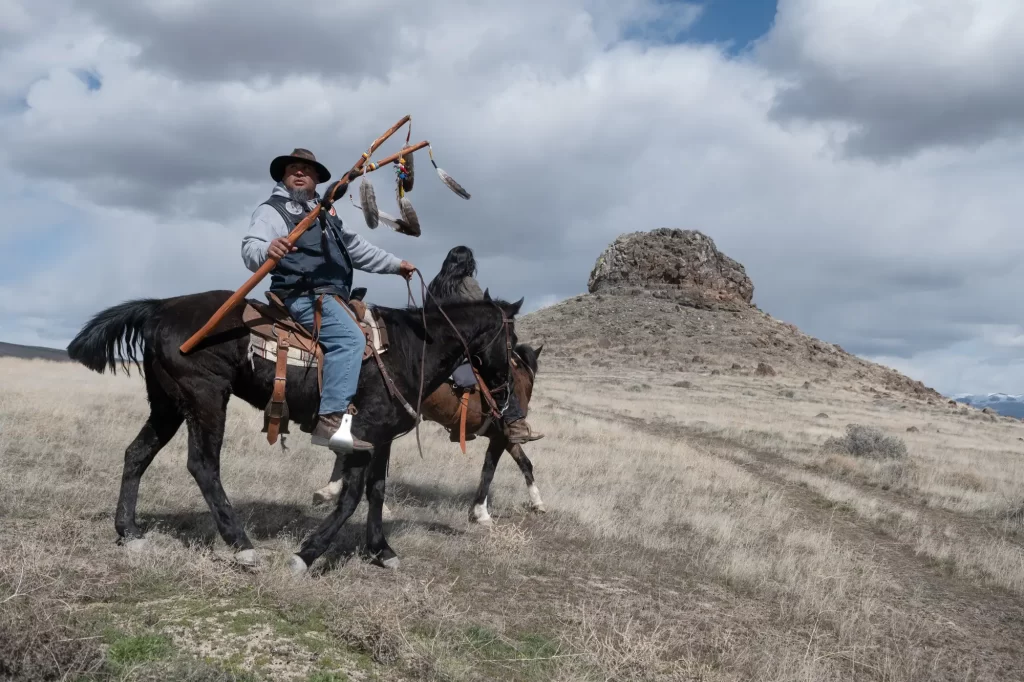
The subjects of the surveillance include the People of Red Mountain. According to the People of Red Mountain website, the group is “a committee of traditional knowledge keepers and descendants of the Fort McDermitt Paiute, Shoshone and Bannock Tribes working in coalition with allies to protect our ancestral homelands.” Their opposition to the mine stems from concerns around destruction of cultural resources, wildlife habitat, and ground water.
Opposition to mining in the McDermitt Caldera also revolves around the disproportionate impact the one-to-one transition from fossil fuel to battery powered vehicles is expected to have on Indigenous land and sovereignty. Demand for lithium is expected to skyrocket 350% by 2040 largely due to use in electric vehicles’ rechargeable batteries, and 85% of known global lithium reserves are on or near Indigenous people’s lands. In December 2024, NATO declared lithium “essential [to] the Allied defence industry” and “integral to the manufacture of advanced defence systems and equipment.”
In the face of these concerns, records show that the Federal Bureau of Investigation, Bureau of Land Management, Humboldt County Sheriff’s Office, Bureau of Indian Affairs, Nevada State Police Highway Patrol, Winnemucca Police Department and Nevada Threat Analysis Center all monitored the mine’s opponents despite their largely non-confrontational methods of hosting educational and cultural events to resist construction of the mine. The use of private companies and public law enforcement to monitor and suppress Indigenous communities follows a pattern of targeted surveillance employed during previous fossil fuel infrastructure projects such as the Jordan Cove Energy Project and the Dakota Access Pipeline.
For more information about the public records and surveillance in the McDermitt Caldera, we encourage readers to read “‘Under the Microscope’: Activists Opposing a Nevada Lithium Mine Were Surveilled for Years, Records Show” by Mark Olalde on ProPublica’s website.
Media Generated
ProPublica, July 23, 2025
“Under the Microscope”: Activists Opposing a Nevada Lithium Mine Were Surveilled for Years, Records Show
By Mark Olalde